FBR POS Integration in Pakistan
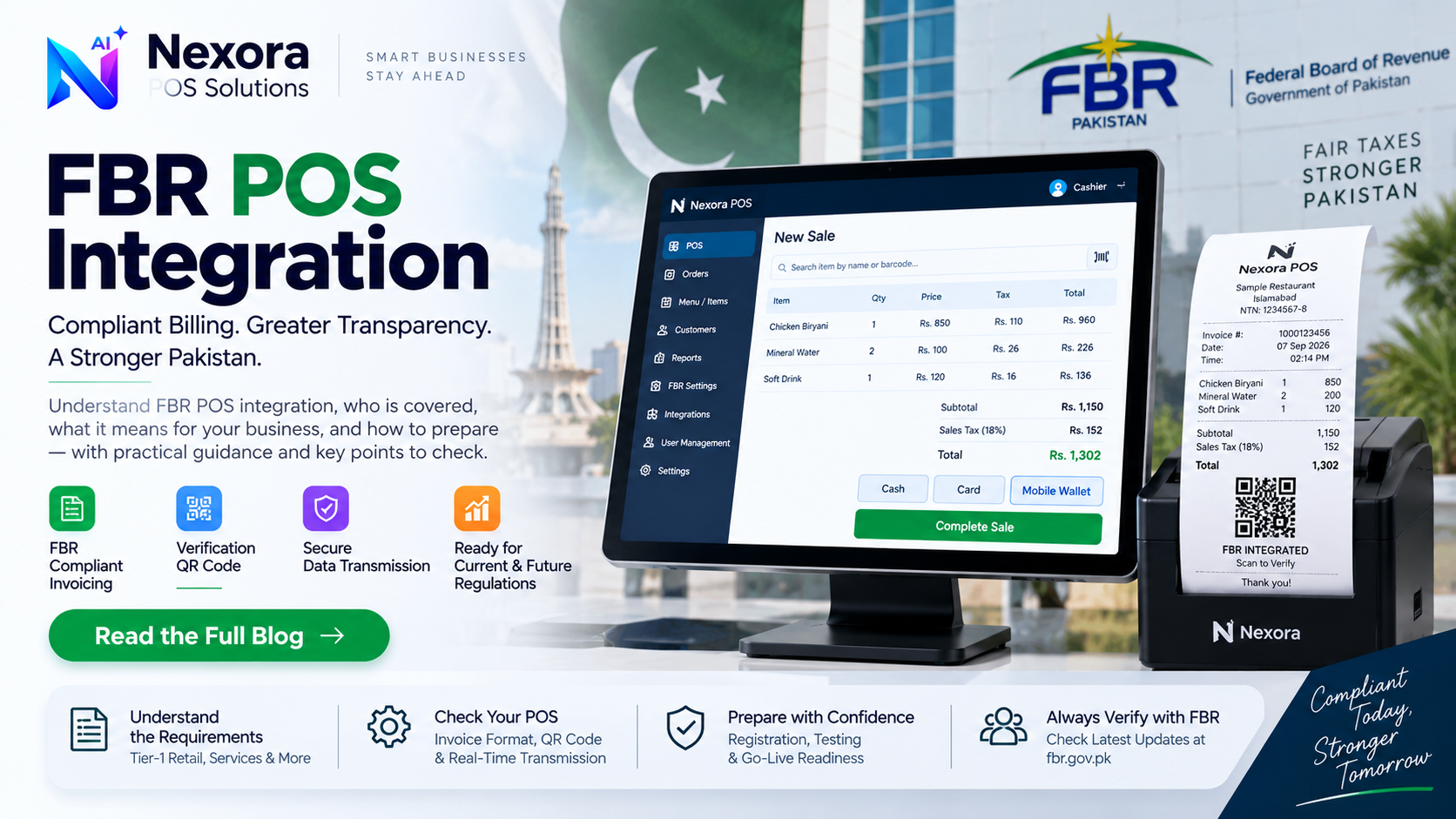
An overview of FBR POS integration in Pakistan — who it affects, what businesses should prepare, and questions to ask a POS provider. Not legal advice.
Before you rely on this article
This article explains FBR POS integration in general terms and is not legal or tax advice. FBR rules in this area have been actively changing through 2026, with reported deadlines and affected categories varying between sources. Always confirm your specific obligations directly with the Federal Board of Revenue (fbr.gov.pk), the IRIS portal, or a qualified tax advisor before acting on any date or requirement mentioned here.
FBR POS integration refers to connecting a business point-of-sale system directly to the Federal Board of Revenue computerized system, so that sales are reported and invoices are issued in a way FBR can verify — typically with a unique invoice number and a verification QR code that a customer or auditor can check. The long-standing version of this requirement applies to "Tier-1 retailers" under Pakistan sales tax rules.
Separately, FBR has been extending electronic invoicing and integration obligations to more sectors through 2026 rule-making, including service providers and other notified categories beyond the original Tier-1 retail definition. The scope of who is covered has been a moving target this year, which is exactly why confirming current status directly with FBR matters more than relying on any single article.
Under the established Tier-1 retailer rules, businesses are generally covered if they are an outlet or franchise of a national or international brand, operate in an air-conditioned shopping mall or plaza, or have exceeded a specified electricity bill threshold over a 12-month period. Restaurants, retail stores and pharmacies are all businesses that can fall into this category depending on their specific setup.
Beyond Tier-1 retail, 2026 rule changes have named additional categories in various stages of notification — including certain service providers. Because this list has been actively debated and updated, do not assume your business is or is not covered without checking current guidance.
If your business may be covered, the practical preparation steps are the same regardless of exact deadline: confirm your registration status and category with FBR or a tax advisor, check whether your current POS system can generate the required invoice format (unique invoice number, tax details, verification QR code), and understand what data needs to be transmitted and how.
It is also worth building in time for testing before any go-live date — integration issues are easier to catch and fix before they affect real customer transactions.
Part of integration typically involves registering your point-of-sale system and receiving identifying credentials from FBR for that connection. A POS system used for this purpose generally needs a way to record and reference that identification consistently, since it is tied to your registration rather than being something invented per invoice.
Integrated invoicing generally means each sale needs to carry specific information — invoice number, date and time, item details, tax amounts, and a verification code — and that this data needs to reach FBR systems in the format and timing required, which is typically described as encrypted, near-real-time transmission under the established framework. The exact technical requirements are set by FBR and its integrator, not by individual POS vendors.
Before assuming a POS system handles FBR integration, ask directly: does the system currently transmit invoice data to FBR systems in real time, does it generate the required verification QR code on receipts, and has this specific integration been tested and confirmed working, not just planned. A vague "FBR compliant" claim on a features list is not the same as a working, tested integration.
Nexora restaurant POS settings currently include a field to record a business FBR / POS integration ID for reference. This is a record-keeping field, not, on its own, a confirmed real-time e-invoicing or QR-code transmission integration with FBR systems — if full FBR integration is a requirement for your business, confirm directly with Nexora what is and is not currently supported before relying on it for compliance.
FBR's own site (fbr.gov.pk) and its published POS Integration FAQ are the authoritative sources for current requirements, categories and deadlines. Because 2026 rule changes (including updates made under SRO 288(I)/2026 extending integration to additional sectors) have been reported by multiple Pakistani business and tax publications, cross-checking recent coverage from established outlets alongside the official FBR guidance is a reasonable way to stay current — but the final word on your obligation is FBR's own notification, not any third-party article, including this one.
Frequently Asked Questions
Is this article legal or tax advice?
No. It is a general overview to help you understand the topic before speaking with FBR directly or a qualified tax advisor. FBR requirements, categories and deadlines should be confirmed through official channels.
Does having a "FBR POS ID" field in software mean I am compliant?
No. A field to record an identification number is not the same as a working, tested real-time integration with FBR systems. Confirm exactly what any software actually transmits to FBR before assuming compliance.
Who should I contact to confirm if my business is affected?
FBR directly (fbr.gov.pk or the IRIS portal) or a qualified tax advisor familiar with current sales tax and e-invoicing rules — requirements have changed multiple times in 2026 and are the most reliable source for your specific situation.
Related Articles
- Free Invoice Generator for Indian Freelancers: Create PDF Invoices Without Excel — 1 min read
- What Is POS Software? — 1 min read
- Cloud Business Software Security Basics for Owners — 1 min read
- SaaS vs Desktop POS Software: Which Model Fits Your Business? — 1 min read